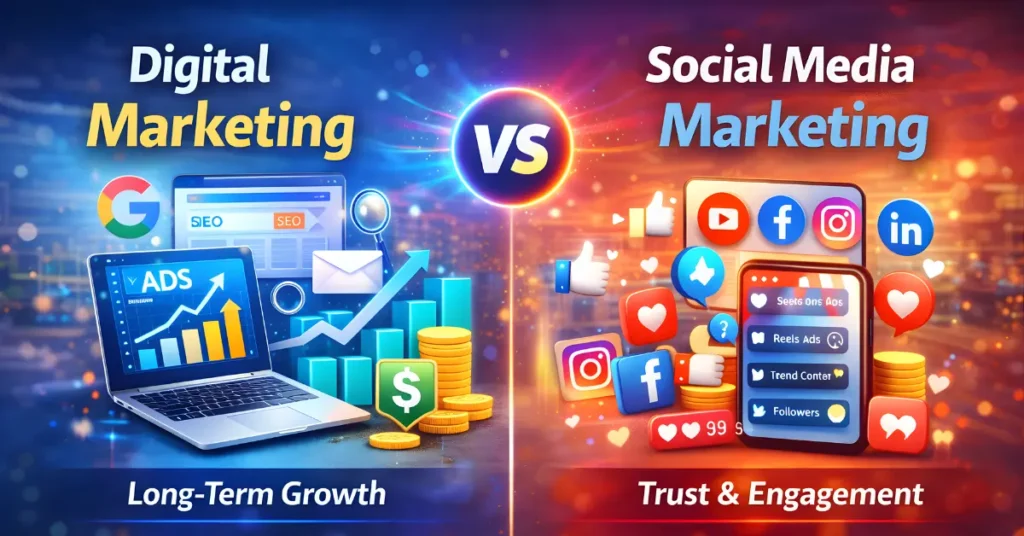
Businesses today are more digital than ever, but many brands still confuse digital marketing vs social media marketing. While both are essential for online growth, they are not the same. Understanding the difference helps businesses invest their budgets wisely and achieve better ROI.
In 2026, with AI-driven search, short-form content dominance, and intent-based advertising, knowing how these two strategies work together—or separately—has become more important than ever.
What Is Digital Marketing?
Digital marketing is a wide term that encompasses all marketing activities done online to advertise products or services via the online means.
- The Major Digital Marketing Elements.
- Search engine optimization (SEO)
- Google Ads & Paid Search
- Filled with content (blogs, landing pages).
- Email Marketing
- Affiliate Marketing
- Website Optimization & CRO
- Online PR- Reputation Management.
Social media marketing is not the entire strategy of digital marketing but rather a subset of it.
What Is Social Media Marketing?
Social media marketing focuses only on promoting brands through social platforms such as:
- YouTube
- X (Twitter)
Its primary goals are:
- Brand awareness
- Audience engagement
- Community building
- Lead generation through content and ads
Social media marketing relies heavily on visuals, trends, short videos, and storytelling.
Digital Marketing vs Social Media Marketing: Core Differences
1. Scope
- Search engines, websites and emails are includes in Digital Marketing.
- Only Social Media platforms includes in Social Media Marketing.
2. Traffic Intent
- Digital marketing (SEO and Google Ads) targets high intent users searching for solutions.
- Social Media Marketing targets on interest based audiences who ready to buy your services or products.
3. Long-Term vs Short-Term Results
Social media focuses on short term engagement.
SEO and content marketing offer long-term growth.
Which Is Better for Business Growth?
There is no universal solution to digital marketing as opposed to social media marketing.
The digital marketing is optimal when:
- You desire regular traffic on the websites.
- Your objective is sales or lead generation.
- You are search based customers.
- You want long-term growth
Use of social media marketing is ideal in cases where:
- You are sociable and story telling.
- You would like to create brand awareness.
- Your product is trend or visual driven.
- You would like to attract younger readers.
Role of SEO in Digital Marketing
As the percentage of Google Discover, AI overlays, and zero- click searches grow, content quality and semantic relevance are becoming more significant than ever.
SEO helps businesses:
- Competitive key word ranking.
- Build authority and trust
- Minimize reliance on paid Ads.
- SEO is not something that can be substituted by social media.
Paid Ads: Digital vs Social Platforms
Paid ads tend to contain in digital marketing:
- Google Search Ads
- Display Ads
- YouTube Ads
On social media marketing, the advertisements will be in the form of:
- Instagram Reels Ads
- Facebook Feed Ads
- LinkedIn Sponsored Posts
Search ads are demand capturing and social ads are demand creating. Smart brands use both.
Why Businesses Need Both in 2026
Instead of choosing digital marketing vs social media marketing, successful brands combine both.
A balanced strategy:
- Uses SEO for long-term traffic
- Uses Google Ads for quick leads
- Uses social media for trust & engagement
- Uses content to support all channels
This integrated approach delivers higher conversion rates and stronger brand recall.
Industry Trends Shaping This Debate
- AI-powered search results
- Short-form video dominance
- Voice & local search growth
- Privacy-focused ad targeting
- Google Discover traffic surge
These trends make full digital marketing strategies more important than platform-only marketing.
FAQs (Client-Searched & High-Intent)
Q1. Is social media marketing part of digital marketing?
Yes. Social media marketing is a subset of digital marketing.
Q2. Which is better for sales: digital marketing or social media marketing?
Digital marketing usually performs better for direct sales due to search intent.
Q3. Can a business survive with only social media marketing?
It’s possible, but risky. Without SEO or website traffic, growth depends heavily on algorithms.
Q4. Is SEO still important in 2026?
Yes. SEO remains critical for long-term visibility and Google Discover traffic.
Q5. Which is more cost-effective?
SEO and content marketing are more cost-effective long term, while social ads need continuous spending.
Read More: Digital Marketing Agency for Dentists